
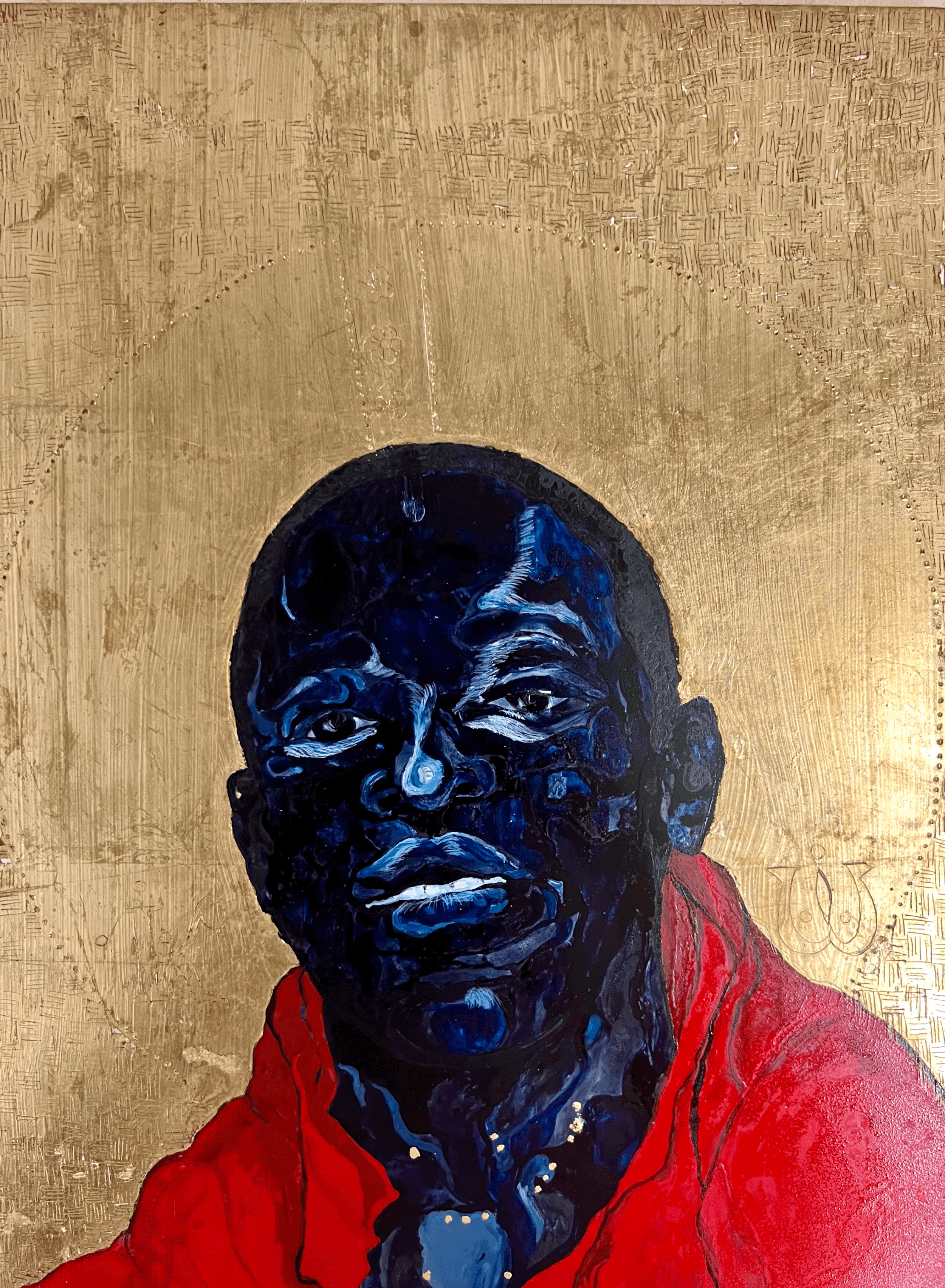
Orain As Icon
When I began this painting, I did not yet know it would become an icon. I only knew I was trying to hold on to someone who had already begun slipping from reach.
He is Orain here—that was his nickname, the way we say it in Jamaica—and it is central to how I remember him: not as a statistic or a cautionary tale, but as a constellation: luminous, scattered, held together by invisible lines and borders that only those of us who have been displaced know how to find.
I painted his skin in indigo, a color that carries the weight of the African diaspora—migration, survival, endurance, and memory. Indigo is not just pigment; it is labor, extraction, trade, and the forced movement of Black bodies across oceans and centuries. To render him in indigo was to situate his life within the much longer history of Black displacement and endurance, to acknowledge that what he carried was never his alone.
At his neck, I painted a blue cravat marked with gold dots mapping the constellation from which he was nicknamed. Gold—precious, celestial, enduring—becomes a language of honor here. The constellation is both guide and witness, as he was: attracting everyone with his warm embrace, his brilliant smile, and the innocence behind his eyes. Sailors once navigated by Orion. Enslaved people once looked to the same stars for direction, for freedom, for hope. In this painting, Orion is not lost; he is fixed in the sky, impossible to erase, just as our history is impossible to erase.
When I received the call that he had passed, regret arrived before grief—immediate and unrelenting.
I regretted not having loved him up enough to quiet the noise in his head.
I regretted not having loved him up enough to make up for the missing softness of a mother’s caress—something he so desperately pursued, often in the wrong places, often at great cost.
I regretted not having loved him up enough to make up for the countless days the police harassed him for being a young Black kid riding his bike on the parkway—for existing too freely, too visibly, in a body already marked as suspect and overvalued only in death.
This painting is about loss, but it is also about overpolicing. It is about how Black bodies are surveilled, criminalized, and exhausted long before they are mourned. How tenderness is rationed. How care arrives late, if at all. Mental illness did not take him alone; it was amplified by systems that refused him gentleness and safety.
By turning him into an icon, I refuse disappearance. I insist that his life mattered beyond the circumstances of his death. Orion the constellation is made of stars light-years apart, yet from Earth they form a figure—a protector, a story passed down through generations. In the same way, this painting gathers fragments—indigo skin, gold stars, blue cloth, and grief—binding them into something tangible that says, I see you. You were here.
This work is an offering. A belated love letter. A reckoning with my own limits and the brutal consequences of a world that demands Black resilience without providing Black care.
If I could have him again, I would love him louder. I would love him softer. I would love him in a way that might have helped him stay.
Instead, I paint him into the sky. And there he remains.
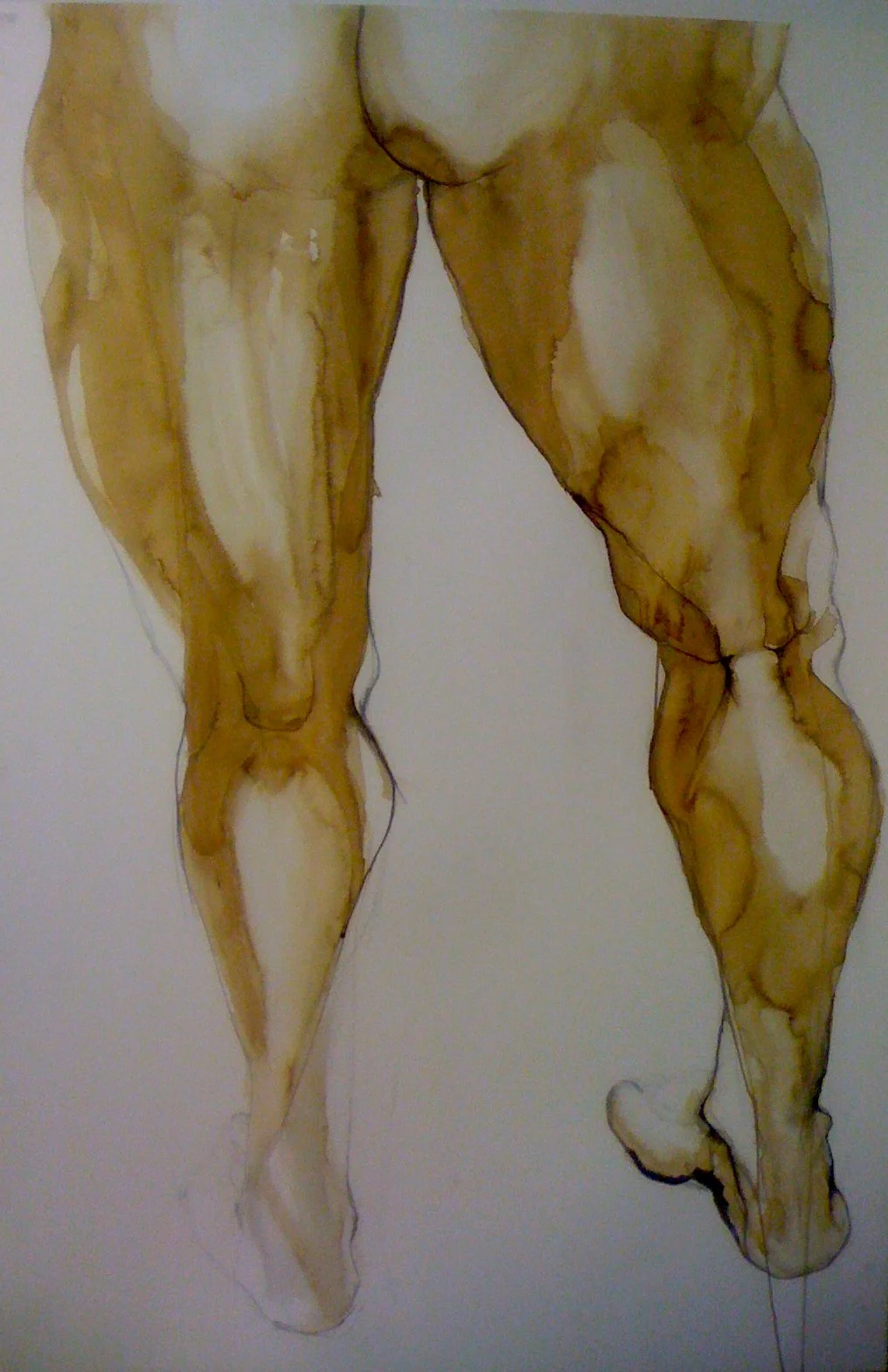
About Coffee Legs
He paced in the shadows of the kitchen.
I sat on the bar stool chair that was given to him by a former professor.
"Just a gift" he had said, "Just a gift."
Him, clearly mad.
Me, feeling not too bad.
He talked. I listened.
Our gaze was distracted as I slowly looked down
A sliver of warm sunlight cross contouring my thighs
How fascinating the light of the sun's caress
This brown in my skin is truly a gift.
I thought "This is something he will never understand."

Inspired by the Nina Simone Song “Four Women”
These paintings are part of a series that celebrates the struggles, experiences, and strength of the black female body.
I wanted to highlight the grace with which we carry all that we have to walk through life, things forced upon us and burdens not belonging to us.
“Strong enough to take the pain, inflicted again and again.”
There were times when we were down and we had to crawl to survive, times we had to run and wail to survive. In all of that, and with all those experiences, still, we rise and walk triumphantly. Sometimes we walk like Peaches and are labeled ‘Angry’.
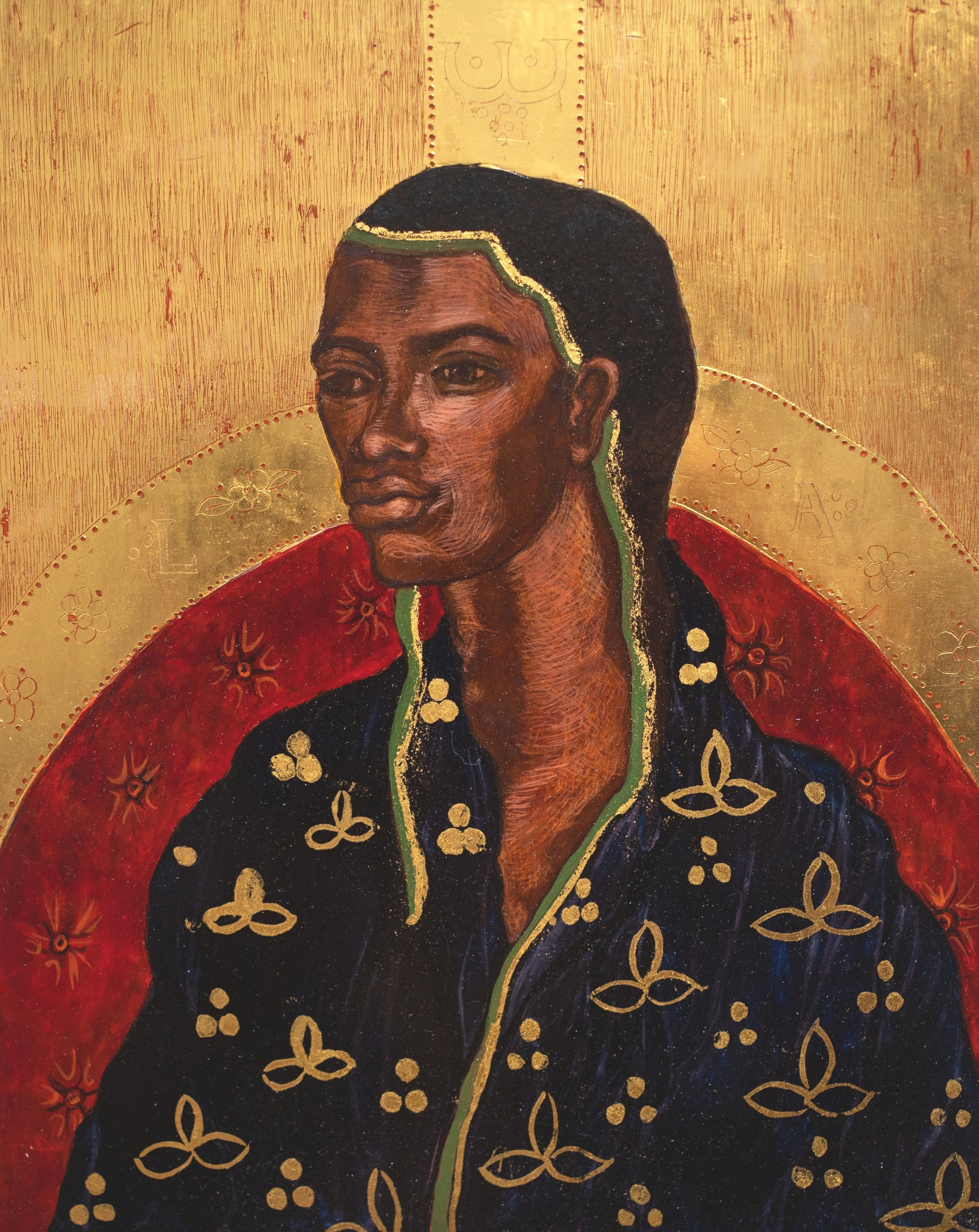
The Absence of Black Bodies in Traditional Art Narratives
This painting is a part of a series of works that address the absence of black bodies in traditional art narratives.
In this series, I wanted to include the presence of black people in stories where we fit, but have been intentionally extinguished and deleted, thereby ‘conning’ some people into believing that black people can’t be in these stories.
Now suddenly the memory of Daniel’s words comes to me “His garment was white as snow, and the hair of His head was like clean wool…”
I want us to see ourselves in the sacred places and stories of the past and know that we belong in the ones to come, despite what others think.
He is an icon for those whose stories deserve to be told.

Unrequited Love and Internal Conflicts
In this piece we see Daphney in her moment of transition after she has been violated by Apollo…
Unrequited love and internal conflicts. In this piece we see Daphney in her moment of transition after she has been violated by Apollo.
“He feared that she would fall and injure herself as she fled, and yet he could not give up the chase.”
The myth says that he couldn’t control himself and was under Cupid’s spell. She never desired him and ran from him, like Artemisia to England, and Marget Garner to Ohio. This is the moment right after she tripped and fell to the ground.
“But his hand was on her arm…”
In that moment Daphney begins a transformation that she will never recover from. I believe it’s important that men in our society learn that they can control themselves. Women are not property, responsible for men’s lust, and touching without permission is rape.